A Homeowner Tax Break, and a $21 Million Question for Oviedo and Winter Springs
A big tax break for homeowners — and a projected $21 million hole for Oviedo and Winter Springs over two years. The Winter Springs mayor calls it "survival mode." Who wins, who pays, and what to ask before November.

If you are a longtime Winter Springs or Oviedo homeowner, Amendment 3 is one of the largest property-tax breaks you have been offered in years — proponents estimate the average homeowner would save around $2,000 a year. If you are a renter, a small commercial landlord, or a city trying to keep the lights on, it is a projected $21 million hole across our two cities over two years, and someone will have to fill it.
That is the tension in the property-tax measure Seminole voters decide in November. The numbers behind it come from the county's own property appraiser and Winter Springs' mayor is already using the words "survival mode."
The county's numbers
A slide from the Seminole County Property Appraiser estimates that seven Seminole cities would together give up about $55 million in ad valorem (property-tax) revenue across the 2027-28 and 2028-29 fiscal years. In both projected years, Winter Springs and Oviedo show the two steepest percentage reductions of any city on the chart.
Winter Springs is projected to lose $2.38 million in 2027-28 (a 22 percent reduction) and $4.14 million in 2028-29 (a 38 percent reduction). Oviedo is projected to lose $5.15 million (18 percent) and then $9.19 million (33 percent), one of the largest two-year dollar totals on the chart. Together, the two cities account for roughly $21 million of the county-wide $55 million, about 38 percent of the total, from just two of the seven cities.
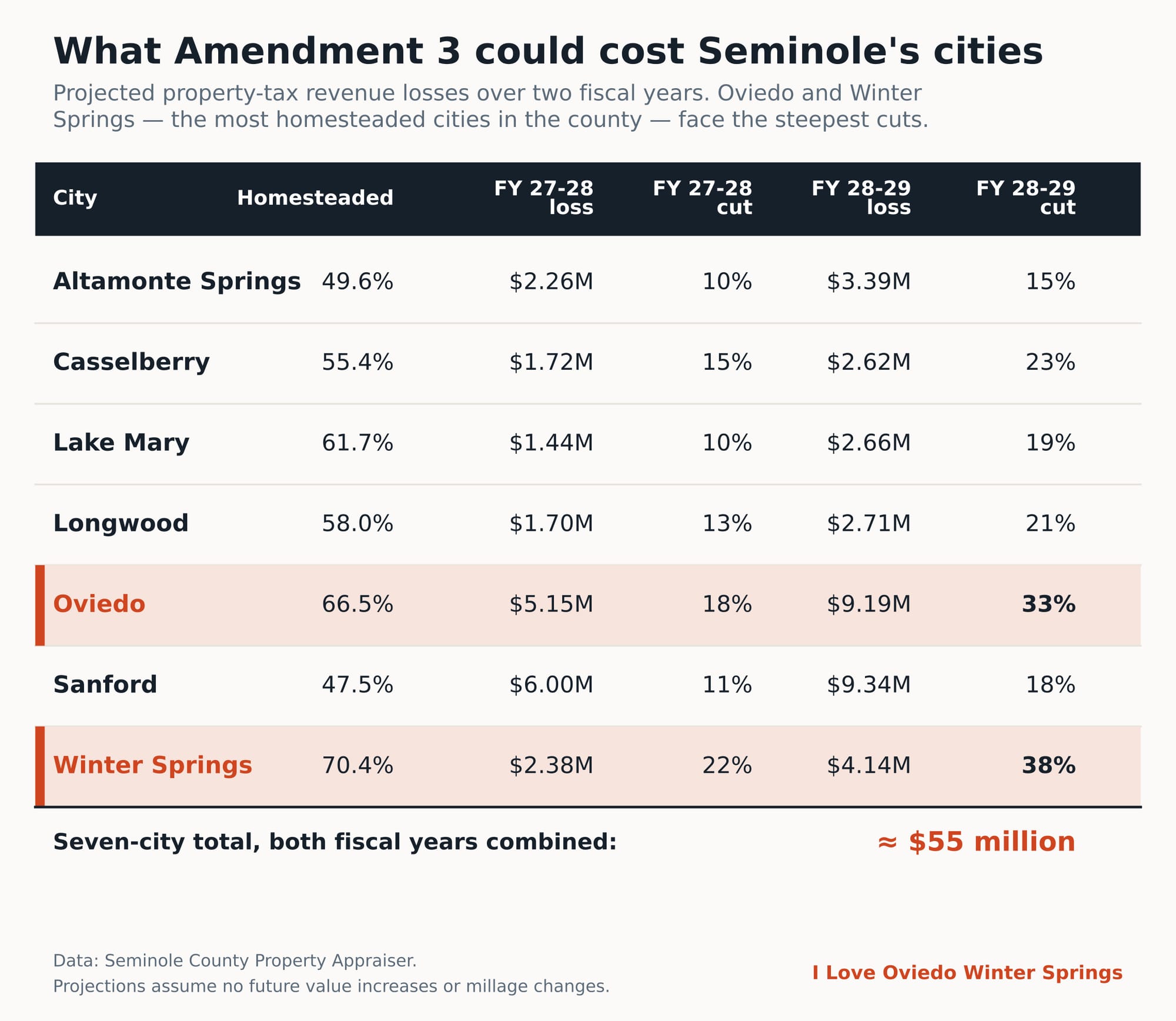
Source: Seminole County Property Appraiser. One caveat sits in the fine print of the slide: the projections "assume no future increases in values or changes to millage rates." The figures are a static snapshot; rising values or a change in millage could offset part of the loss.
Who wins, who feels it
Winter Springs has the highest homestead rate of any city in the county — 70.4 percent of parcels — which is exactly why its projected percentage hit is the steepest. The exemption at the center of Amendment 3 applies only to owner-occupied primary homes, so the more homeowners a city has, the more revenue it stands to lose.
Winter Springs Mayor Kevin McCann does not dispute the math. "It's going to be a challenge for every city. It will be survival mode," he told the Orlando Sentinel, noting that because Winter Springs is so heavily residential, it is among the Central Florida cities most dependent on the homestead property taxes the amendment targets.
The residents who benefit most on paper are the ones who have lived here longest. Decades of Save Our Homes caps have held their assessed values far below market, and a larger exemption stacks another break on top. Former Oviedo Mayor Dominic Persampiere put it in plain terms with his own home: after 30 years he pays about $4,000 in property taxes, he said, while a neighbor in an identical house bought two years ago pays about $8,000.
The residents most likely to feel a fee shift are the newer buyers and non-homestead owners, renters, through their landlords, and small commercial property owners who get little or no exemption to offset new charges.
Where the money comes from
Cities cannot print money, and Florida municipalities must balance their budgets. That leaves three realistic paths to close a gap this size: cut services, raise fees, or both.
McCann has been blunt about the first. Even if Winter Springs shut "every single park," cut all youth recreation programs and eliminated funding for the Scottish Highland Games and its fireworks shows, he told the Sentinel, it "still wouldn't be enough to balance the budget without that tax money." Officials "will make it work," he said, "but I don't think folks understand the change that will take. It will be a different city."
The other lever is fees. The charges cities typically reach for fire assessments, stormwater, solid waste, recreation, share a feature that matters here: non-homestead owners pay them too. That is the shift Persampiere warned about. The expanded exemption "is only going to make the system worse and shift the tax burden to non homestead properties," he said, and a flat fire fee would land on renters and small landlords "who received no tax break." Persampiere holds non-homestead property, rental homes and a beach condo, that would not get the expanded exemption; he acknowledged the point when a resident raised it.
Public safety is the largest exposure. Across Seminole County, officials estimate the amendment would cut more than $188 million in revenue, and county figures show about 41 percent of property-tax dollars go to law enforcement and 31 percent to fire and emergency operations. The measure lists public safety among the allowed uses of property taxes, but it contains no provision shielding those budgets from the cuts.
What the amendment actually says
Voters will see rewritten ballot language for the measure, a proposed change to Article VII and Article XII of the Florida Constitution. According to the official summary, the amendment would:
- Raise the homestead exemption for all non-school taxes to $150,000 in 2027 and $250,000 in 2028, adjusting for inflation after that.
- Reduce the annual cap on assessment increases for non-homestead property from 10 percent to 5 percent.
- Require counties and municipalities to use property taxes solely for public safety, education and schools, infrastructure, natural resources, bond debt service, employee retirement benefits, and operations and administration — with other spending subject to approval by local officials.
- Give people who are not Florida residents as of Dec. 31, 2026, only the existing exemption until their fifth year of homestead.
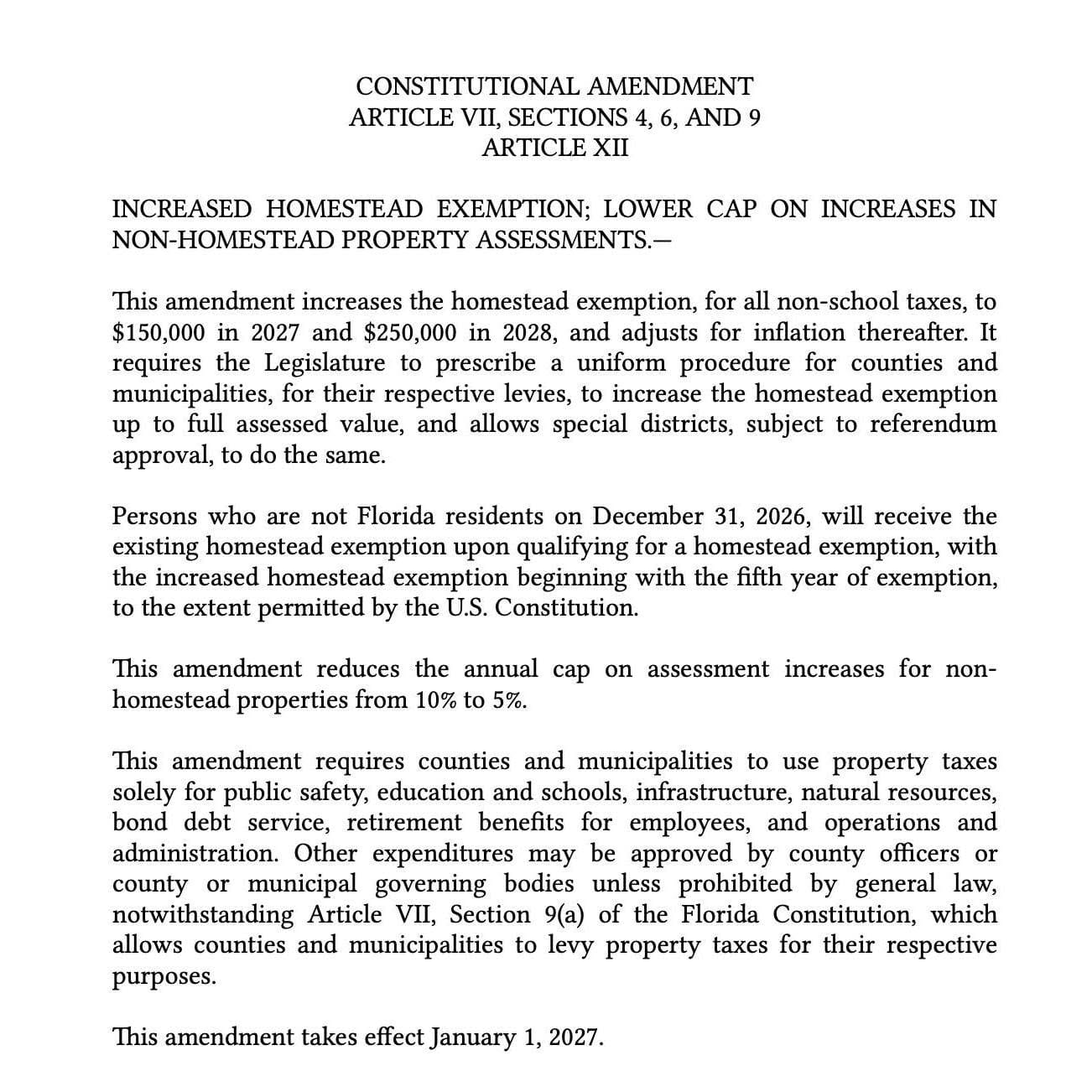
The measure would take effect Jan. 1, 2027, and school-tax revenue would be shielded from the new exemptions. Notably, the summary contains no provision resetting existing homestead assessments to market value, a fear that has circulated online but that the appraiser rejects, saying "portability, Save our Homes, etc. stay the same."
The wording is a revision; the measure's earlier ballot summary had been challenged as misleading. Oviedo Mayor Megan Sladek called the rewrite "the new and improved ballot language," writing that it "accurately and truthfully articulates the measure that we will be voting on in November" and "deserves genuine consideration on the merits." She did not take a position for or against the amendment itself.
The case supporters make
Supporters say the relief is overdue; the homestead exemption has not been raised since 2008 even as values and tax bills climbed. Gov. Ron DeSantis, who proposed the measure, has waved off the warnings of service cuts. "Did we not have schools and police in 2019 when they were taking in $32 billion? Of course we did," he said at a recent press conference, arguing local revenues have doubled since 2019. His chief financial officer, Blaise Ingoglia, has called the cities' warnings "scare tactics" from "apologists for big government." Proponents estimate the average homeowner would save about $2,000 a year, according to an Orlando Sentinel analysis, a tempting figure amid Florida's affordability crunch.
Critics counter that the carrot obscures the cost. "Dangling that carrot of $2,000 cash makes you feel good, but it doesn't address what services you are willing to give up for that, or wind up paying some other way," state Sen. LaVon Bracy Davis, D-Orlando, told the Sentinel. The measure needs 60 percent approval to pass a bar that sank exemption-increase amendments in both 2018 and 2022.
Before November, ask three questions
A chart will not answer the hard part. Before you vote, put three questions to your Oviedo City Council and Winter Springs City Commission:
- Which services are non-negotiable and which ones are you willing to cut?
- Which fees are already under discussion to backfill the lost revenue?
- How much of the gap do you plan to close with cuts versus new charges?
The answers are how you will know what Amendment 3 means for your street.