Oviedo Wants to Explain the Property-Tax Amendment to Voters. Its Own Leaders Can't Agree How.
Two days after a court struck the property-tax amendment's ballot language as misleading, Oviedo officials met to plan how to explain it to voters — and split over the line between education and advocacy. Here's what the amendment would actually do.

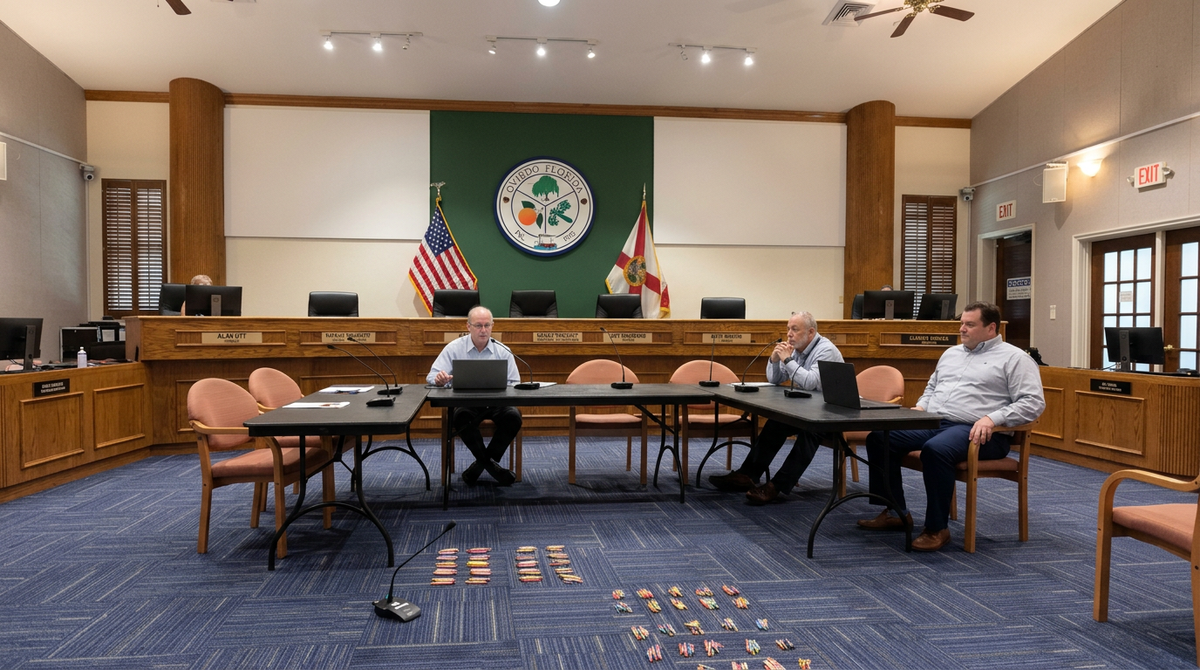
OVIEDO — The city is preparing to hold public meetings this fall to help residents understand the property-tax amendment on the November ballot. But a recorded August 5 work session shows Oviedo's own leaders divided over how — and whether — to do it, with Mayor Megan Sladek repeatedly calling the planned presentations "propaganda" and spending much of the two-hour meeting counting a bag of crayons for an online giveaway.
The session, livestreamed and archived by the city, brought together Sladek, Councilman Alan Ott, and senior staff. It came two days after a court delivered a striking judgment on the measure they were preparing to explain.
A court just called the ballot language misleading
On August 3, a Leon County circuit judge ruled that the amendment's ballot title and summary were "clearly and conclusively defective" and ordered them rewritten.
In a final summary-judgment order, Judge David Frank found the proposed title — "Save Our Homes From Excessive Property Taxes" — was "a political slogan," not a neutral description, and that it misleadingly borrowed the name of "Save Our Homes," a popular and unrelated 1992 constitutional cap the amendment does not touch. He found the summary's four selling points — that the measure "benefits Florida taxpayers," "ensures funding for core services," "protects small businesses," and "ensures fairness for Florida residents" — were "political rhetoric, not neutral, not explanation."
The court did not strike the amendment; judges can't. Instead it ordered Attorney General James Uthmeier to submit rewritten ballot language within 10 days and barred the Secretary of State from using the original version. A court-compliant rewrite — and a final ballot number, which had not yet been assigned — will go before voters in November. That unassigned number is part of why the measure has been hard to name: it has circulated locally as "Amendment 3," but that number is not official, and the Department of State does not assign one until the language is fixed.
What the amendment would actually do
Because the order lays out both the struck language and the amendment's real text, it offers the clearest public accounting yet of what the measure (formally, House Joint Resolution 1F) would do:
- Raise the homestead exemption in two steps. It would exempt the first $150,000 of a homestead's value from non-school property taxes beginning in 2027, rising to $250,000 in 2028, adjusted for inflation afterward. The struck summary implied the full $250,000 would take effect immediately — which the court called inaccurate.
- Cut the assessment cap on other property. It would lower the annual cap on assessment increases for non-homestead property — commercial buildings, rentals, second homes — from 10% to 5%. The struck summary called this "protecting small businesses"; the court found the amendment never mentions small businesses and gives them no special protection.
- Not guarantee funding for police, fire, or schools. The struck summary claimed the amendment "ensures funding for core services." The court found the opposite: it creates no new funding guarantee, and "by substantially reducing the local property tax base," is "likely to decrease the revenues available to local governments to fund core services."
- Not require eliminating property taxes. The struck summary said it "requires … a schedule for full elimination." The court found the text only lets the Legislature create procedures under which local governments may choose to grant larger exemptions over time.
- Give renters no benefit. The court noted renters would see no exemption and would "likely pay more" if landlords pass along higher taxes from any resulting millage increase.
- Make new residents wait. People who establish Florida residency after December 31, 2026 would get only the existing exemption until their fifth year.
"Propaganda," and a bag of crayons
Against that backdrop, Sladek questioned whether the city should hold informational meetings at all.
"Everybody knows that we have a predisposed — the majority of people that work for the government don't like it," she said. "And you're showing up to be convinced why you should also not like it. It's insulting to people." A city presentation, she argued, would amount to telling residents, "here, we're going to spoonfeed you propaganda."
Her skepticism was not only rhetorical. Through much of the session Sladek counted and bundled crayons for a Facebook giveaway — an on-the-record protest of a meeting she called a waste of time. Her preference, she said, would be to skip presentations and hold only a resident-driven question-and-answer session: "Anything that's not audience-driven, I'm out." A government messenger, she added, is compromised by definition: "It can't be somebody on our team … Somebody who's neutral has to say this stuff or nobody's going to believe it." She pointed to the League of Women Voters, which she said plans its own nonpartisan sessions.
Ott pushed back, arguing the city can present facts without slanting them — and warning that the mayor's posture could sink the effort. "If it's done in a way that you have contempt for it, it will undermine it, whether you intend to or not," he said. He pressed for a factual framework: showing residents the original and revised ballot language side by side, and correcting specific misunderstandings — including the belief, which he and Sladek agreed is mistaken, that the amendment guarantees police and fire funding or prevents the city from raising its millage rate. Those are the same gaps the court identified in the state's ballot language.
The irony was left hanging in the room: Sladek doubted the city could be a neutral messenger on the amendment — while the court had just found the state's own official framing of it was not.
What it means for your tax bill
Beneath the debate over messaging sat the substance most residents will care about: what the amendment would do to Oviedo's finances, and how the city would respond.
By Sladek's own figure, "49.5% of our budget comes from homestead properties". If the exemption expands, the city loses a share of that ad valorem — property-tax — revenue, and officials were candid that they do not intend to simply absorb the loss. "At least three people here are going to vote to do whatever it takes to get as much money as we did the year before," Sladek said, characterizing where a council majority stands. Elsewhere she was more measured: "I do not want to replace the revenue 100%."
The mechanics staff walked through pointed the same direction — if property-tax revenue falls, it is made up somewhere else. The options discussed included:
- A fire assessment fee — a "non-ad valorem" charge based on a formula rather than property value. Because it is not a property tax, it sidesteps the homestead exemption entirely. Oviedo has used one before.
- Consolidating or sharing police and fire services with Seminole County, including a possible joint fire station — though officials doubted turning police over to the Sheriff would save residents money.
- Raising the millage rate, which the group noted would "shift the burden to commercial" property and to "renters."
That last point is the recurring reality of these debates, and one the court underscored: a change marketed as relief for homeowners can move the cost onto businesses, renters, and non-homestead owners, or reappear as a fee. A fire service funded through millage and the same service funded through a fee cost roughly the same to run; what changes is who pays, and how visibly.
The statewide price tag
The scale of what the amendment would remove from local budgets is large. State economists projected it would cut local, non-school property-tax revenue by about $4.95 billion in fiscal year 2027-28 and $8.78 billion in 2028-29, with a recurring hit of roughly $11.86 billion a year once fully phased in — figures from the state Revenue Estimating Conference, cited in the Legislature's final analysis of the bill and repeated in the court's order.
A work session, not a decision
This was not the full council. Only Sladek and Ott attended, alongside staff, and no votes were taken. The mayor herself said the council still needs "a discussion of the whole council … to figure out what people want to do." Any decision on whether, where, and how to hold the meetings — and how Oviedo would respond if the amendment passes — would come at a future public meeting. The first informational session had been tentatively targeted for mid-September.
I Love Oviedo Winter Springs will continue to follow the amendment and the city's response.